REPORT ON THE WORKSHOP AND AWARENESS DRIVE ON E-WASTE MANAGEMENT
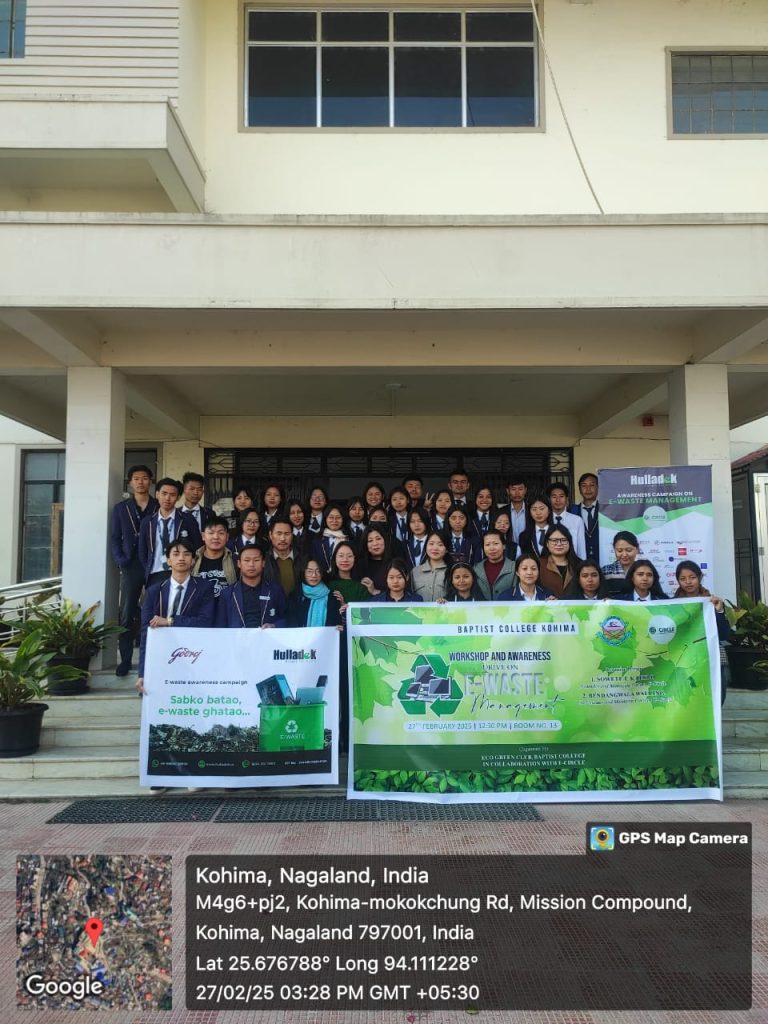
The Eco Green Club of Baptist College Kohima, in collaboration with E-Circle, successfully organized a Workshop and Awareness Drive on E-Waste Management on 27th February 2025 at Baptist College, Kohima. The event aimed to deepen participants’ understanding of e-waste issues and promote sustainable management practices through interactive, locally relevant sessions.
The program commenced with opening remarks by Mr. Asilie Rürhia, the Chairperson, who welcomed the audience, outlined the order of the day, and introduced the resource persons while providing a brief overview of E-Circle—a pioneering waste management firm established in 2018 in Chumoukedima, Nagaland. An invocation was then led by Ms. Zhangukhono, setting a reflective tone for the proceedings.
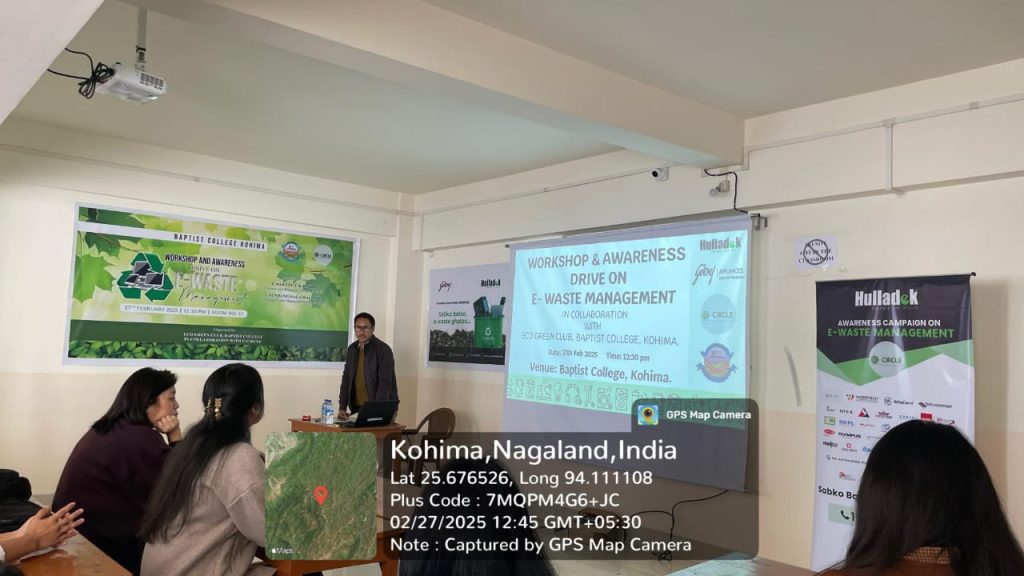
The workshop was structured into four sessions. In the first session, titled “Fundamentals of E-Waste Management,” presented by Bendangwala Walling, the students were actively engaged using a constructivist approach. They were encouraged to identify examples of e-waste from their everyday surroundings—such as broken earphones and outdated mobile phones commonly observed in households in Kohima and Dimapur. The discussion covered the definition of e-waste as outlined in the E-Waste Management Rules, 2016; a historical timeline tracing global milestones from the mid-1970s Resource Conservation and Recovery Act (RCRA) in the USA to the 2003 Waste Electrical and Electronic Equipment (WEEE) Directive in the European Union; the criteria for classifying devices as e-waste; the causes of e-waste generation driven by economic growth, technological advancements, and consumer behavior; and key statistical insights, including the global generation of 62 billion kg of e-waste in 2022 and India’s ranking as the third-largest producer.
The second session, “End-of-Life Cycle E-Waste,” also presented by Bendangwala Walling, delved into the complete lifecycle of Electrical and Electronic Equipment (EEE). The session explained that each device undergoes an active use phase, a passive period, and a storage stage. It examined the materials used in these devices—from metals and plastics to glass and hazardous substances—and highlighted the health risks associated with improper handling. Various post-usage options were discussed, including repair, resale, refurbishment, recycling, and treatment for items that cannot be recovered. A comparative analysis of the linear economy—which often culminates in informal dumping and unmanaged landfills in regions such as Kohima and Dimapur—and the circular economy, which emphasizes collection and recycling to reduce environmental impact, underscored the need for sustainable practices.
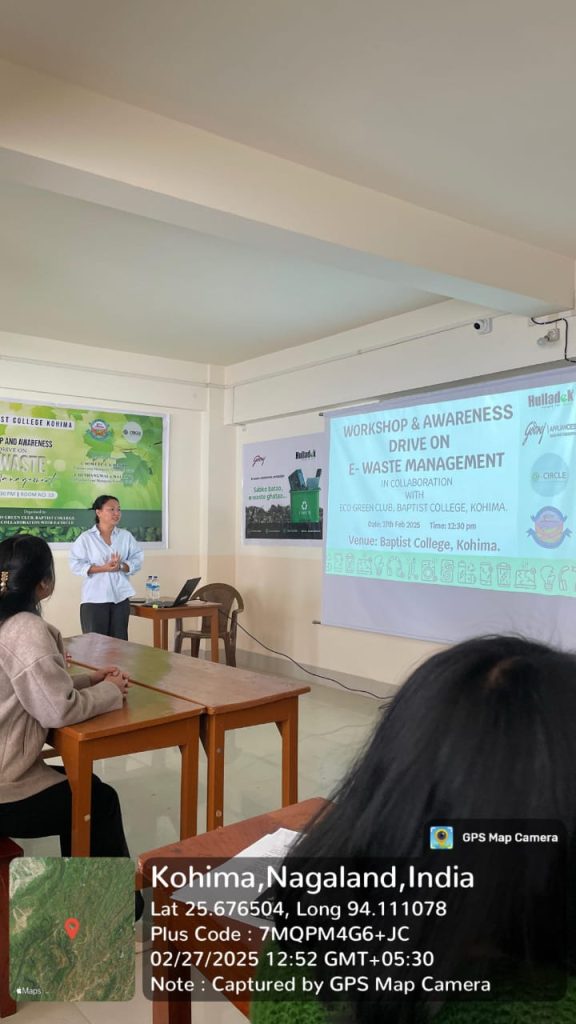
The third session, “E-Waste (Management) Amendment Rules 2024,” was presented by Miss Sowete-ü K Lekro. This session provided an in-depth review of India’s regulatory framework for e-waste management. It traced the evolution of the rules—from their introduction in 2011, notification in March 2016, and enforcement from October 2016, to the most recent amendments made in March 2024. Miss Lekro detailed the structure of these rules, which encompass eight chapters, five schedules, and seven forms, and explained their applicability to manufacturers, producers, refurbishers, dismantlers, and recyclers. Emphasis was placed on the necessity of handling e-waste solely through authorized channels, mandatory registration with the Central Pollution Control Board (CPCB), and the implementation of Extended Producer Responsibility (EPR) to ensure the environmentally sound management of end-of-life products, along with compliance measures such as periodic returns and penalties for non-compliance.
The fourth session, “Relation Between Different Stakeholders and the Process of E-Waste Management in India,” was also presented by Miss Lekro. In this session, the interconnection between various stakeholders in the e-waste management ecosystem was explored. Her presentation addressed the roles of government bodies such as the Ministry of Environment, Forest and Climate Change and the Central and State Pollution Control Boards in policy formulation and enforcement, as well as the responsibilities of manufacturers under the EPR framework and the critical functions of recyclers, dismantlers, and collection centers. Local challenges, particularly in areas like Dimapur where informal recycling practices are prevalent, were highlighted. A comparative review of the linear economy—ranging from mining to landfill/incineration—and the circular economy—emphasizing sustainable practices such as collection and recycling—further reinforced the need for a transition to sustainable management. A special spotlight was placed on E-Circle, the first authorized e-waste collection center in Nagaland. Since its establishment in 2018 in Chumoukedima, E-Circle has reached over 5,000 people and collected and recycled more than 50 tonnes of e-waste, serving as a model for sustainable waste management in the region.
Following the formal sessions, students volunteered to share their learnings, reinforcing the interactive nature of the event. Bendangwala Walling expressed her gratitude for the enthusiastic participation and valuable insights provided by the students.
The event concluded with closing remarks by Ms. Sevolü Chüzho, Convenor of the Eco Green Club, who thanked the resource persons and all participants for their contributions, marking the success of the workshop and awareness drive.
This comprehensive event not only enhanced understanding of the technical, regulatory, and practical aspects of e-waste management but also inspired a commitment among the students to embrace sustainable practices. Let us take a pledge to recycle and reduce e-waste—Sabko Batao, E-Waste Ghatao!